|
Some Jews would
come from Galicia, then a
province of Austria-Hungary, and
from Romania, but most came from the Russian Empire.
In the late 19th century,
enlarged by its acquisitions of
much of Poland, including
Lithuania, Russia was home to the
world's largest Jewish
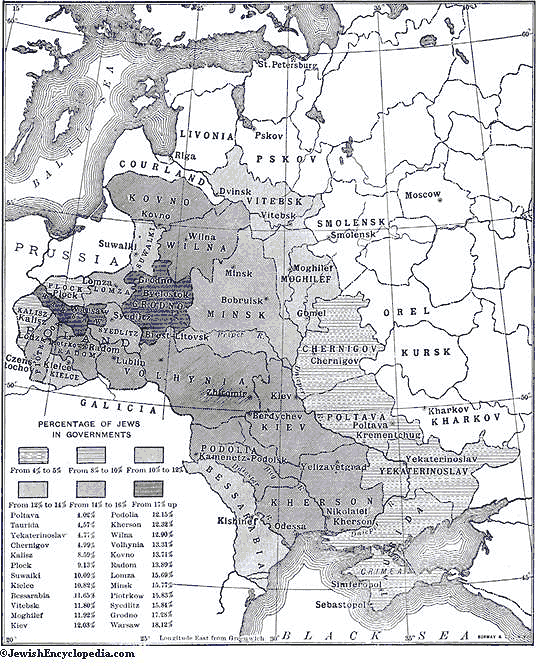
population. Imperial Russia restricted Jews
without special permission to
residing within the Pale (the
boundaries) of Settlement. Five million Jews
lived there, nearly all in
towns (shtetlach) and
villages, for
even within the Pale, cities
like Kiev were closed to Jews.
Russia would
let
Jews who had become more
"Russian" live
outside the Pale of
Settlement. That could be done
by
conversion to Christianity, then by higher
education - but quotas of five
percent Jewish enrollment limited that
option. Army service was also a
way "in", but conscription was
dreaded. It would take boys into
a hostile setting that would try
to convert them.
|
|
(Despite much
family lore, by 1874
conscription had been reduced to
six years, and later to even
less time.)
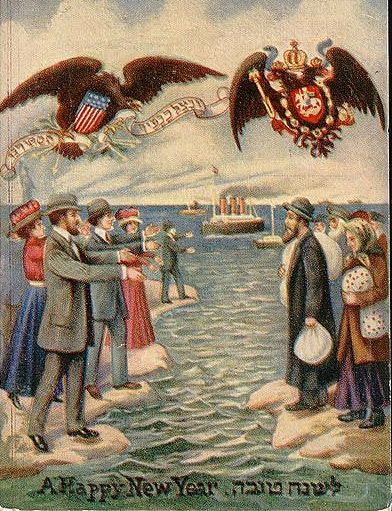
But Russia had no
objection to its Jews leaving.
Though Jews
faced more restrictions than
others, these were hard
times all but the wealthy,
Jew and Gentile.
Jews looking for a land where
they could, at last, be full
citizens, began the first aliyah
to then Palestine.
It is testimony to the Jew not
seeing himself a citizen and not
being seen as one, that a Jewish
immigrant, whose family may have
been in Poland for generations,
would be called a Jewish
American and where he lived
would be known as a Jewish
neighborhood. Yet a Polish
Catholic immigrant would be
called a Polish American and
live in what would be called a
Polish neighborhood. |