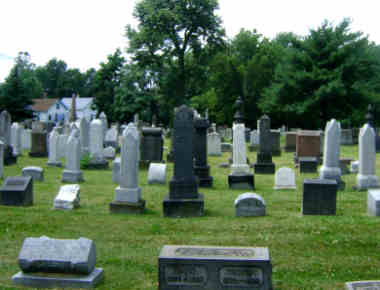
Willet Street Cemetery - 1840 1,500+
burials (sometimes spelled Willett)
Cleveland's first Jewish cemetery.
|
In 1839, soon after
the Alsbacher party of 15
arrived from Unsleben, Bavaria, the Israelitic Society
was formed.
In April 1840 it
petitioned Cleveland City Council for a half-acre section of the Erie (East 9th)
Street Cemetery. City Council said 'no'. City law allowed only the sale of
family plots.
Read the story of that
failed petition.
In July 1840 it arranged to buy an acre of
land in Brooklyn Township on the west side
of the Cuyahoga River for $100 from Josiah
Barber.
See the deed of
sale on our pages.
The Israelitic Society soon became Anshe Chesed
congregation.
Tifereth Israel, founded in 1850, bought about one-third of an acre
south of Anshe Chesed's land from Joel Scranton
on April 20, 1854 for $100. In 1871 and 1881 it
added small adjacent parcels.
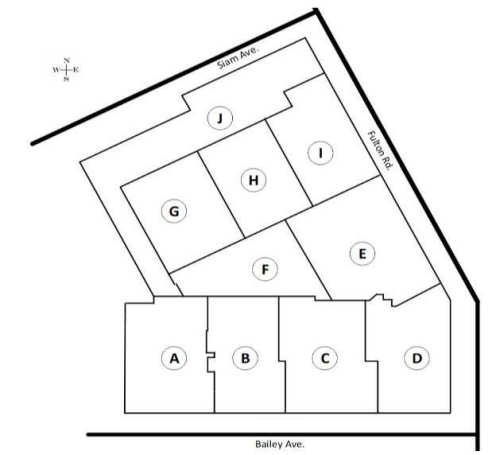
In the drawing below,
sections E - J were owned by Anshe Chesed. A - D by
Tifereth Israel.
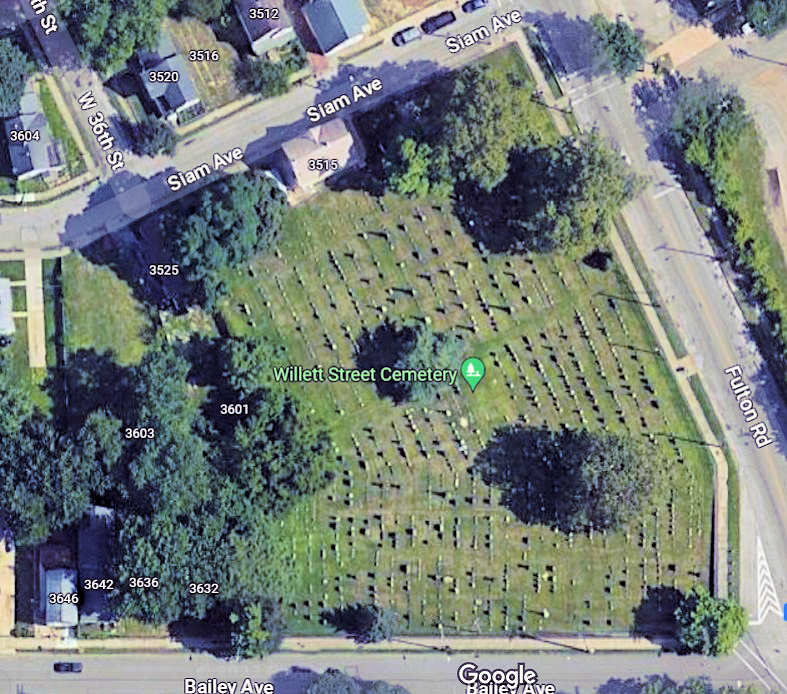
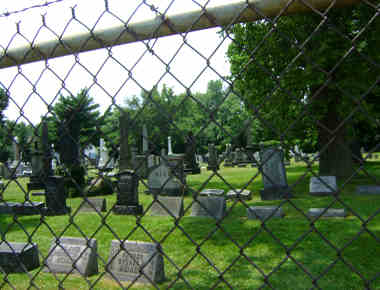
The cemetery is
north of I-90, where Fulton Road (once Willet Street) and Monroe Avenue intersect. The address is 2254 Fulton Road.
The phone number (216) 321-1733 is Mayfield
Cemetery's. |
 |
|
Though headstones will be found here for burials as late as
the 1950s, Willet Street Cemetery has many empty
spaces. They are the result of the removal of graves
to Mayfield Cemetery, for reburial among children
and grandchildren. Examples include
Simpson
and Regina Thorman
and
Moses and Yetta Alsbacher.
Since 1890 Willet
Street Cemetery and Mayfield Cemetery have
been
owned and
maintained by
United Jewish Cemeteries,
an association owned by The Temple - Tifereth Israel
and Anshe Chesed Fairmount Temple.
The website
www.MayfieldCemetery.org includes an informative
History timeline
|
|
|
 |
|
below: Google
Satellite View |
|
 |
|
Who
was the seller, Josiah Barber?
Josiah Barber
(1771-1842) and his partner in real estate development Richard
Lord, owned the land along the lake west of the Cuyahoga River.
They were son-in-law and son of Samuel P Lord, an investor in
the Connecticut Land Company. |
Barber had another
brother-in-law Leonard Eckstein Case Sr. who had also married a
daughter of Samuel Lord. Case managed the sales of the land east
of the Cuyahoga River. In 1843 he would make the
Great Gift to the
Jews of Cleveland — land for their first synagogue. |
|
Why buy on the west side?
To our pioneer Jews, who lived where Progressive Field
stands today, near the Cuyahoga River, the near west side did
not seem so far away. For them, cemeteries were aways outside
the town. |
Cost,
alone, would have ruled out a nearby burial ground. Their one acre
on Willet Street in Brooklyn cost $100. An acre
in the city would have cost $3,000. (For comparison,
Eagle Street Synagogue cost $1,500 to build.) |
|
How did they
cross the Cuyahoga River?
They
probably used the Columbus Street Bridge, built in 1835. It had
a draw section to let vessels pass. It took time and sometimes
money to pay tolls to cross the Cuyahoga. That may explain why
communities downtown would move east, and those west of the
river would move west.
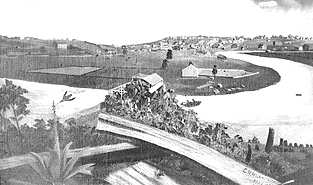
Picture: Columbus Street Bridge
in 1837,
looking northeast. |
 |
|
|
 |
 |
 |
 |
|
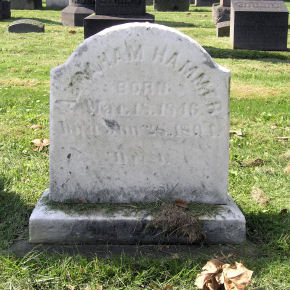
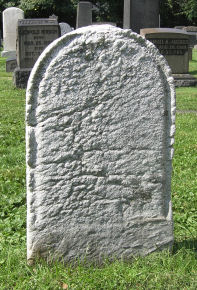
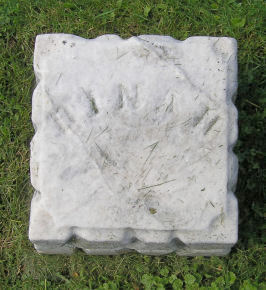
The early marble and limestone headstones
have fared poorly; some are unreadable.
Here on the near west side, near Cleveland's industrial valley with its steel mills and
oil refineries,
and the use of coal
for heating and later to generate
electricity, dirtied the air. |
Later
came auto emissions from the nearby
highways. What we now call
"acid rain" has dissolved the
surfaces. Granite stones, which
began to be used in the 1900s, offer
much more resistance to erosion,
as can be seen at the newer
Mayfield Cemetery.
|
|
|
Is
it spelled Willet or Willett?
Jeffrey Morris, chronicler of our cemeteries, notes on
his page on this cemetery that
early maps and deeds spell the name
both ways. City
Council Archives say it was Willett. |
We
prefer Willet. That is how
the cemetery's owner, United
Jewish Cemeteries, spells it. Perhaps
because the deeds of sale, from Josiah Barber
in 1840 and Joel Scranton in 1854,
also say Willet. |
|
|
The
first burial at Willet Street
Cemetery
A
Bavarian-born peddler named
Alexander Kahnweiler was buried
here on August 7, 1840, the same day
the deed to the cemetery was recorded. |
For
the
story of that day, a challenge to
our community and we believe is the
reason our first congregation
chose the name Anshe Chesed,
click here. |
|
|
|