|
At a meeting
on March 27, 1899 "uptown" Jewish leaders try to weaken
"Czar" Bernstein's grip on "downtown" Jewish voters. |
|
On Monday
March 27, 1899, shortly before Cleveland's
hotly contested mayoral election, a
reform-minded group held a public meeting in
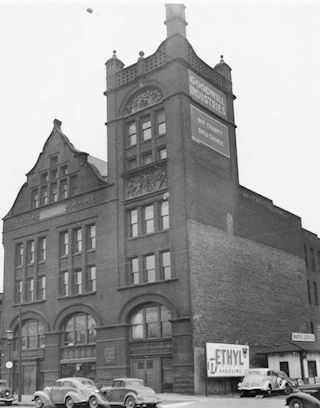
Germania Hall on Erie Street and Bolivar Avenue,
one street north of present day Progressive
Field.
The aim of
this meeting was to appeal to the voters in the
Lower Woodland area - largely immigrant Eastern
European Jews - the poor and working class
voters in "Czar" Harry Bernstein's 16th ward.
Bernstein would direct them to vote a straight
Republican ballot. But the "good government"
candidate was a Democrat. So leading Jewish citizens
would appeal to the audience
to act as free Americans and not be
subjects of any "czar." The next day's
Plain Dealer described the meeting in
detail. It also reported how Bernstein
offered a free Yiddish play at the same time to
reduce attendance at the meeting. |
|
 |
|
Germania Hall, built in 1888, demolished in the 1950s.
In this 1940's photo it was occupied
by Goodwill Industries.
Source: Cleveland Public Library collection |
The five leading characters in this
drama were:
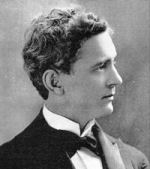 |
Robert McKisson:
age 36, born in Ohio, Republican and a lawyer, had been mayor
since 1895 and was running for re-election. His
administration was a
great builder of bridges and advanced other public projects, but
a citizens group had uncovered its corruption.
|
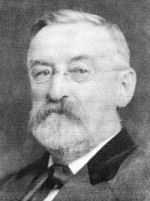 |
John Harrington
Farley, age 53, was born in Cleveland. A Democrat
and known as
"Honest John Farley", he had been mayor from 1883-85.
He had lost in his run for mayor in 1897 and was
running for mayor again. Farley was seen as the "good
government" candidate. |
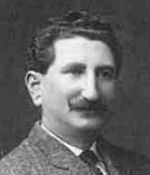 |
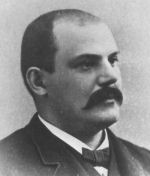
Harry Bernstein:
Republican ward leader, age 43, born in
Russia-Poland. He would boast that he could deliver the
vote in his ward - and he did. So much so that
he was known as "Czar" Bernstein because of the
influence he had over his constituents. He would
meet immigrants from Russia soon after they
arrived, befriend them, help them get out of
trouble and make sure they became citizens. Then
he would tell them who to vote for. His ward was
located in the area where the main Post Office
on Orange Avenue stands today. |
 |
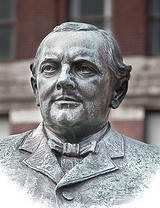
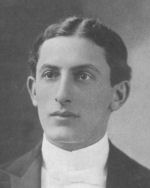
Martin Marks:
age 46, born in Wisconsin, In 1886 he married a daughter
of Kaufman Hays, Cleveland's most wealthy Jew,
and soon moved to Cleveland. An insurance
executive, in 1890 he became president of the
Reform congregation Tifereth Israel, the city's
largest and second-oldest congregation. It was then on Willson Avenue
(now East 55th Street), far east of Bernstein's
Lower Woodland ward. |
|
 |
Rabbi Moses Gries:
age 31, born in New Jersey and, since 1892 the first
American-born and American-educated rabbi of The Temple -
Tifereth Israel. Eloquent and confident, he soon became
the leading voice of the Jewish community.
Gries, too, had married a daughter of Kaufman
Hays. He can say "I have worked with your
children" because his Sunday School
welcomed children of non-members. His comment about a
fire engine running through crooked refers to a street
with a bend in it to avoid moving Bernstein's saloon. (see
Bernstein's Elbow). Three years before he had helped
found the
Municipal Association, which would later become The Citizens
League. |
|
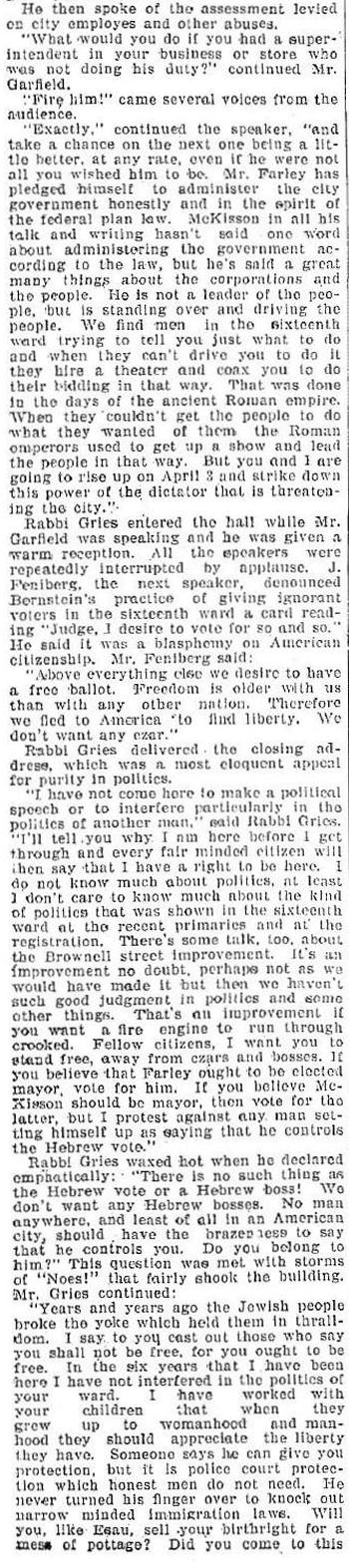
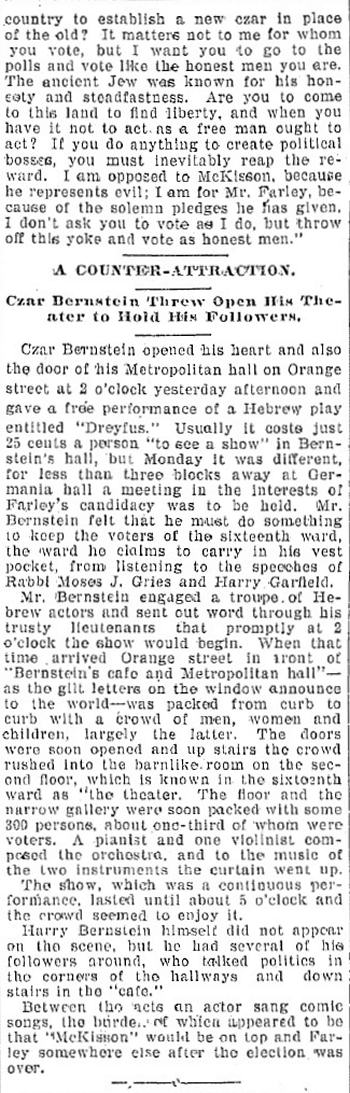
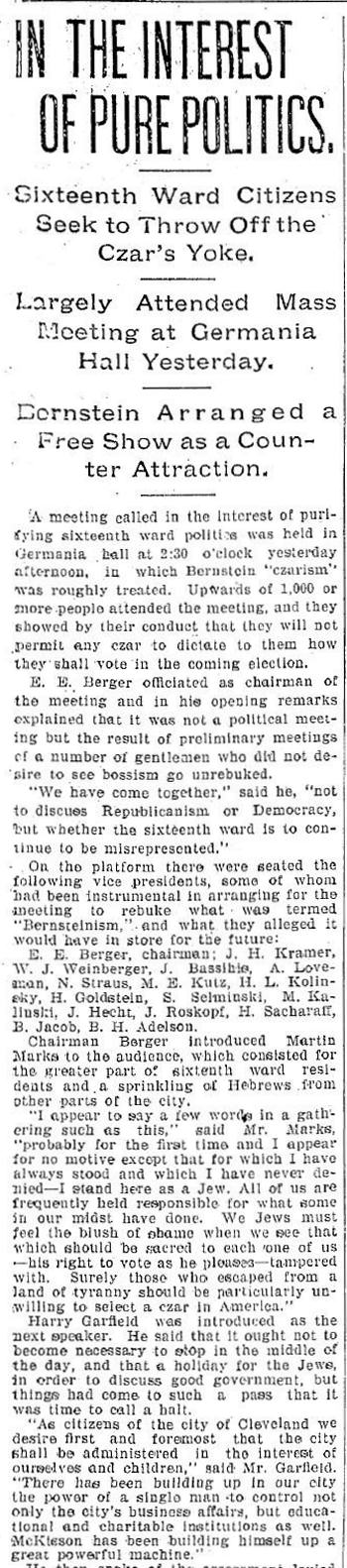
We display the story of March 28, 1899 below. Not clear and
not mentioned in the story is how well
the largely Yiddish-speaking voters of
Bernstein's ward would have understood the
speeches in English.
The Jews who organized the
meeting could be called "uptown Jews". Gries
and Marks lived on East 93rd Street (then named
Oakdale), north of Euclid and south of Hough.
They were within one
block of Kaufman Hays, whose daughters they had
married. (Later they would all move to a family
compound overlooking Lake Erie.)
The Jewish newspaper of the time,
the Jewish Review and Observer, made no
mention of the meeting for the two weeks before and
after it was held.
Photo sources:
McKisson and Farley (Wikipedia),
Bernstein, Marks, Gries (Merging
Traditions)
Arnie Berger December
24, 2010 updated June 3, 2018, Nov 2, 2020 |
|
|
The story
as it appeared in the Cleveland Plain Dealer of
March 28, 1899. |
|