|
|
ZIONISM | |
|
|
ZIONISM | |
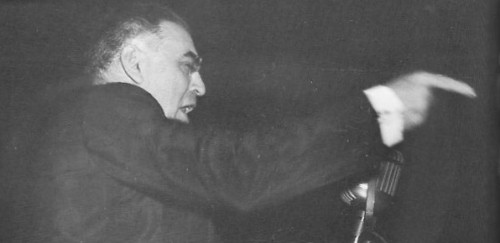
Rabbi Abba Hillel Silver
was a life-long champion of the cause of a Jewish homeland in
Palestine. He was more than a leader skilled in planning strategy
and working at the highest levels; his powerful speeches were heard
by tens of thousands. He would inspire Zionist rallies, appeal to
non-Zionist Jews to accept the movement's goals, and appear before
Christian groups to win their support. This page will present only three episodes in his lifetime of Zionist activities. None of them were available on the web in 1998 when this site was created.
July 1943 See endnote: Stephen S. Wise In May 1942 the Biltmore Program showed that Zionists were accepting Abba Hillel Silver's leadership, not Wise's. See endnote: the Biltmore Program. Then in July 1943, at a large and contentious American Jewish Conference meeting in New York's Waldorf-Astoria hotel, Abba Hillel Silver rose to the leadership of American Zionism and with the support of David Ben Gurion displaced Stephen S. Wise. Two essays on the web document this.
These articles are well-written, carefully researched descriptions of a turning point in modern Jewish history. Medoff focuses on the change in leadership; Libo-Skakun covers a much longer time span. We suggest reading them both. Although Wise would be listed with Silver as a co-chair, that was a gesture. Decisions were made by Silver only. The years of contention between the two had ended. Silver and Ben Gurion would work together to make history. See endnote: Wise and Silver.
1947 The United Nations partition resolution
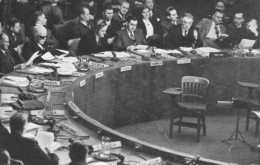
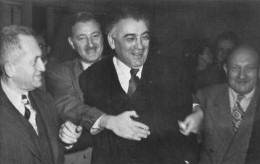
For larger photos, click here. The left photo above shows the essential moment in Abba Hillel Silver's work to establish the State of Israel. As chairman of the Jewish Agency for Palestine he is at the United Nations in November 1947, seated in the first row. At his right is the Soviet Foreign Minister Andrea Gromyko. Seated behind him are Emanuel Neumann, Golda Meir and Moshe Sharett. Only David Ben Gurion, who shared leadership with Silver, is missing. He was delayed in Israel and for that reason Silver (introduced as Dr. Silver) presented the case. What is being discussed will become U.N. Resolution 181, a plan for Palestine to be partitioned into an Arab state and one controlled by Jews. with Jerusalem being jointly controlled. (Nearly 60 years later, "two state solutions" are still being discussed.) To read the resolution, see how each nation voted and hear the votes being cast, click here. Those familiar with Silver's eloquence can imagine what happened. He presented the case for Israel so movingly and effectively that the vote passed. Then we see the photo on the right: a jubilant Silver being embraced by Moshe Sharett. Not so. It was not one dramatic day. In 1947 the U.N. investigated and deliberated not for a day or a week; its meetings spanned seven months, from May through November. Jewish representatives were allowed to sit in on most of these meetings. During the U.N.'s discussions and for years before there had been much work outside the U.N.: writing, speaking to huge rallies and conventions, meeting in small groups and one-on-one, garnering the support of people everywhere - politicians and the public, Jews and Christians. Silver's public role in the U.N. campaign began on May 8 with a presentation to the First (Political) Committee. More speeches would follow: Moshe Sharett and David Ben Gurion on May 12; Abba Hillel Silver and Chaim Weizmann in October. Not until November 29 would the partition plan, Resolution 181, be approved. (See the timeline on the pages of the Israel Ministry of Foreign Affairs.) The Zionist delegation, including Abba Hillel Silver, stayed in a hotel in New York. Silver would live in New York and spend his days there or in Washington, with many trips home to Cleveland for the weekend. He was completely focused on this process, thanks to The Temple having granted him an indefinite leave. His energy and drive were invaluable, his replacement of an ailing. less forceful Stephen S. Wise most timely, and his close working relationship with David Ben Gurion very effective. It must have been the best of times, for he was working to realize a lifelong dream. The Spielberg Jewish Film Archive has made available much of his presentation before the Ad Hoc Political Committee of the General Assembly on May 8, 1947. The clip in incorrectly titled Day of Decision. Silver, introduced as Dr, Silver, can be heard starting at 2:34 Watch the video.
January 1948 Abba Hillel Silver confronts Harry Truman
To say that theirs was not a cordial
relationship would be an understatement. We show below an excerpt from a
long, well documented page
President Harry S. Truman and US Support for Israeli Statehood
on
www.mideastweb.org
Truman and the
American Zionist leaders had a tense relationship, with Harry Truman
coming to resent their "pressure" tactics. Yet, at the end Truman
supported partition and had to counter our State Department's desire
to do nothing that might endanger U.S. oil interests.
See also a chronology on the pages of the Truman Presidential Library. To learn more
|