 |
Anshe Chesed Synagogue - The Early Years | |
| Eagle Street Synagogue ─ Cleveland's First | ||
|
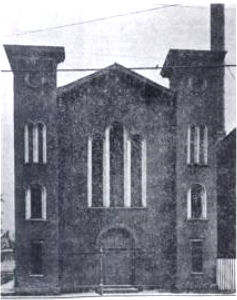
Anshe Chesed, now Anshe Chesed Fairmount Temple, was founded in 1841 and chartered on February 28, 1842. It is Cleveland's oldest Jewish congregation. It was formed after 30 members of the organization of Cleveland's Jews which took the name the Israelitic Society (Israelitische Verein) and held religious services, seceded in a dispute over ritual. Differences were overcome in 1845, and the groups merged under the name Israelitish Anshe Chesed Society of Cleveland. More on Encyclopedia of Cleveland History and Rabbi Moses Gries history of Jewish Cleveland. "As soon as resources permitted, the reunited Israelitic Anshe Chesed Society employed John Wigman, a master builder, to construct Cleveland's first synagogue building. The Eagle Street Synagogue, a modified version of the local Baptist church, was erected on the south side of Eagle Street and dedicated August 7-8, 1846." Text and the photo below are from Merging Traditions page 11. |
|
|
|
Leonard Case was land agent for most of Cleveland's east side, selling the land his father-in-law Samuel P. Lord owned as an investor in the Connecticut Land Company, which had bought the 3.3 million acre Western Reserve. To advance the city's growth, in 1843 Case gave land for the building of several houses of worship. That included land for Anshe Chesed. (See our Great Gift page.) It was the son of Leonard Eckstein Case, Leonard Case Jr., whose estate founded the Case School of Applied Sciences. The lot on Ohio Street (today Carnegie Avenue) was exchanged for lot 38 on the south side of Eagle Street, between Erie Street (now East Ninth) and Woodland Avenue. There, in 1846, for a cost of $1,500 Anshe Chesed built the city's first synagogue. They would now be called the Eagle Street Synagogue. Though it's hard to comprehend a $1,500 building, note that wages for a carpenter were then about $1.30 a day, roughly 1/250th of today's levels. Further, it was a simple building, without gas or electricity, central heating and indoor plumbing. The building cornerstone was laid on October 6, 1845 and the synagogue was dedicated in April 1846. (See our description of the service.) The sanctuary was designed for the traditional custom of separate seating of men and women, with a ladies' gallery along three sides. Two years later dissension would split the congregation again and lead to the formation of Tifereth Israel.
Why was it so difficult to have only one
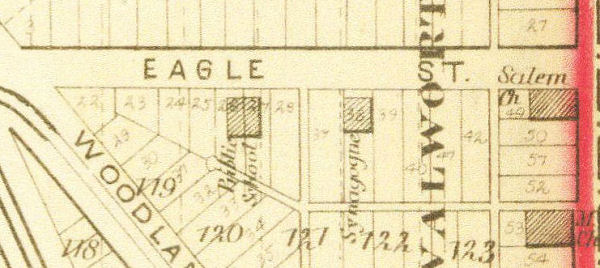
congregation? The early years of Jewish Cleveland are best described in historian Alan Peskin's 1973 monograph "This Tempting Freedom", published by Anshe Chesed Fairmount Temple. It is online in CSU's Cleveland Memory website He writes that the split that led Cleveland, with perhaps 100 Jewish families, to have two synagogues was caused by differences in custom -- "minhag". The first members from Unsleben had brought over worship practices from their isolated Bavarian town. Later, Jews from other German-speaking places arrived, with different customs. The Unsleben faction had control of such practices in Anshe Chesed and would not compromise. As a result, many of the others left to form Tifereth Israel. Learning that the leaders of the faction that left Anshe Chesed were from northwest German-speaking cities gives Peskin's conclusion greater weight, for that is where what we call Reform Judaism began. The Unslebeners, from a village in Bavaria, far to the east and south where more traditional practices would prevail, were in charge. This suggests that the split was between those wanting change and those wanting to worship as their fathers had. Anshe Chesed grew and in 1860 it enlarged the building. The city had improved its water and sewage systems and the expansion probably included indoor toilets. In 1887 they moved to a new building 18 blocks east, at Scovill Avenue and Henry (now East 25th) Street. See history of Fairmount Temple. In 1887 they sold the Eagle Street Synagogue building to B'nai Jeshurun for $15,000. B'nai Jeshurun would occupy it until 1906. See the B'nai Jeshurun history page. In 1927 the original building became a freight depot. See a picture. Where was the old Eagle Street Synagogue? Shown below is an 1850 street map from the Cleveland Public Library Map Room. The vertical red line is Erie Street, now East Ninth Street. The synagogue is about 350 feet west of the center of East Ninth. Central Avenue, Broadway and Woodland begin at the Central Market. |
 |
|
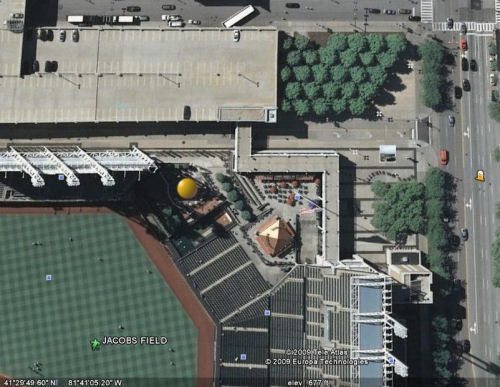
Below: a Google Satellite view of the north-east corner of Progressive Field, home of the Cleveland Guardians. The street running north-south is East Ninth. Eagle Street runs east-west, between the parking garage and ball field.
|
|
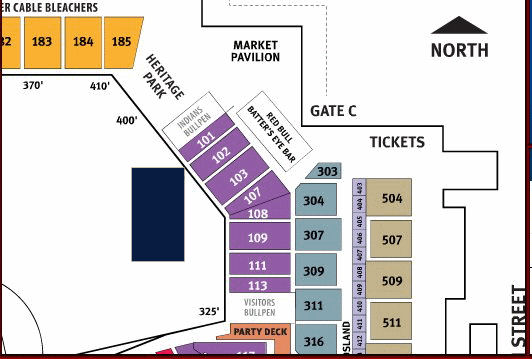
Conclusion: the old Eagle Street Synagogue stood about 100 feet south of Heritage Park. Using a copy of an image from the team website, we show it below as a black rectangle, roughly where it was in 1846. |
|
|
|
Nate Arnold suggested that a plaque near the baseball stadium commemorates the Eagle Street Synagogue. For our "In Pursuit of the Plaque", click here. |
|